
Prospective research program

Decoding how the brain sets protein appetite in health and disease.

We study how neural circuits, membrane excitability, and internal metabolic signals work together to maintain protein homeostasis. Using Drosophila as a tractable systems model, we connect single-cell physiology to feeding behavior, nutrient-specific motivation, and disease-relevant metabolic disruption.

  • Circuits Protein hunger and homeostatic state encoding
  • Methods Electrophysiology, imaging, genetics, behavior
  • Direction Obesity, cachexia, and metabolism-linked disease

Scientific motivation

How does the nervous system decide what the body needs?

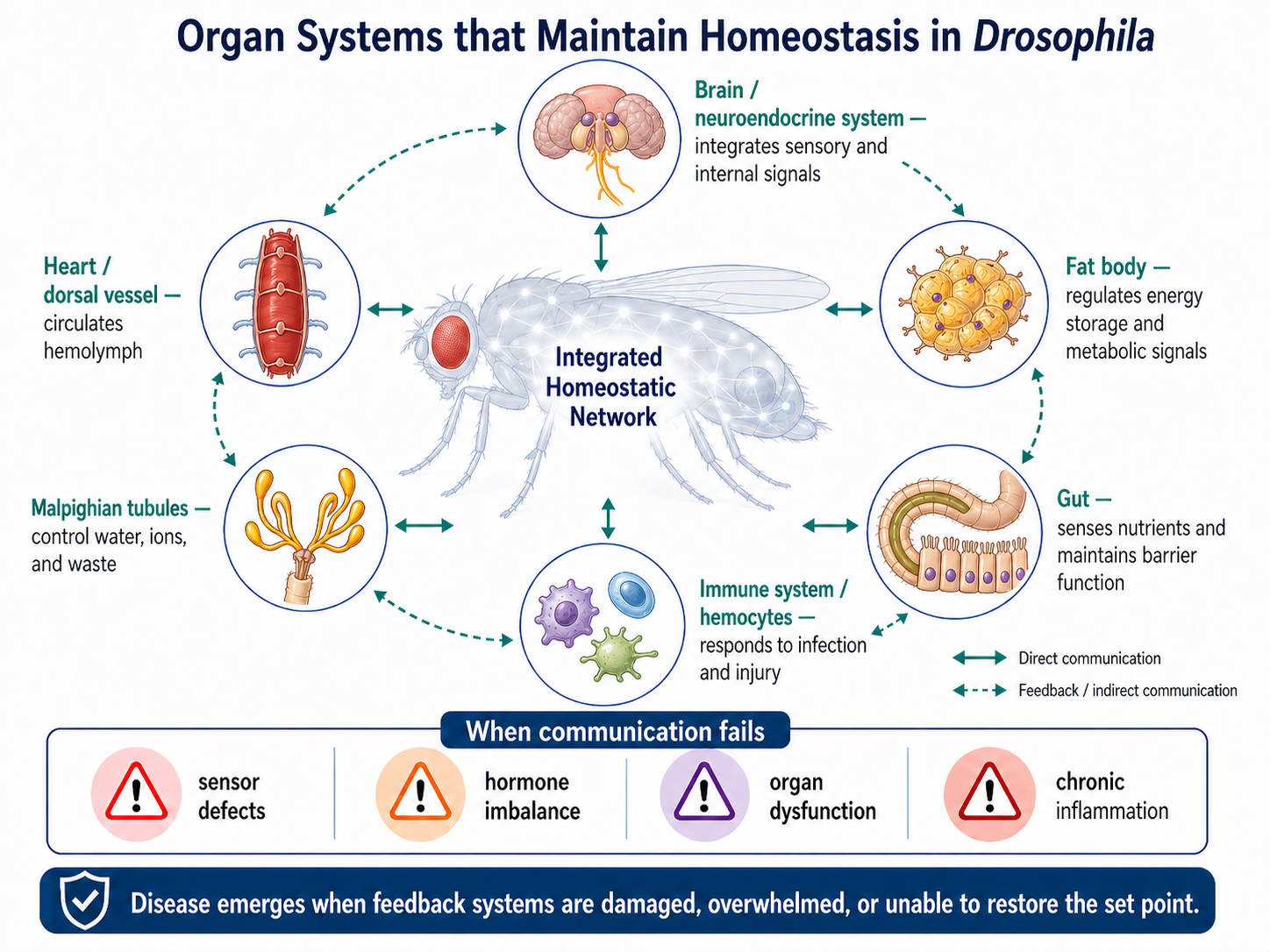
Animals defend internal targets for fundamental needs such as nutrition, hydration, and sleep. Our work asks how those targets are represented biologically, how they are adjusted by physiology, and how they break down in disease states where appetite and metabolism become uncoupled.

Research themes

Three connected questions drive the lab.

01

Encoding nutrient need

We investigate how protein hunger neurons represent intake setpoints and how cellular excitability stores information about internal nutritional demand.

02

Reprogramming appetite

We dissect neuromodulatory and GPCR signaling pathways that tune membrane potential, reshape nutrient-specific motivation, and recalibrate behavioral output.

03

From homeostasis to disease

We extend homeostatic setpoint biology toward obesity, cancer-associated anorexia, and cachexia to understand how peripheral pathology perturbs brain-body communication.

Featured discovery

A physiological variable can store the protein intake setpoint.

Previous work from Guangyan Wu showed that protein hunger neurons encode intake setpoints in their resting membrane potential, linking a homeostatic target to a single trackable electrophysiological parameter. That result opens a broader framework for studying how motivation is programmed at the level of cells and circuits.

“From ion channels to behavior, the goal is to make hidden internal needs experimentally visible.”

Approach

We work across scales, from molecules to motivated behavior.

Experimental toolkit

  • Whole-cell electrophysiology in the fly brain
  • Functional imaging and immunohistochemistry
  • Drosophila genetics and circuit dissection
  • High-throughput feeding behavior analysis
  • Comparative thinking across neuroscience and metabolism

Why this combination matters

Homeostatic control is inherently multiscale. It depends on ion-channel function, circuit logic, internal state sensing, and behavioral choice. By combining rigorous physiology with powerful genetic and behavioral tools, we can ask mechanistic questions that are difficult to access in other systems.

Publications

Publications spanning nutrient homeostasis, ion channels, and circuit physiology.

A selected list is shown below. The full publication record is available on Google Scholar.

2024

Opposing GPCR signaling programs protein intake setpoint in Drosophila

Guangyan Wu et al. • Cell 187(19): 5376-5392

2019

Molecular understanding of calcium permeation through the open Orai channel

Xiaofen Liu, Guangyan Wu et al. • PLOS Biology 17(4): e3000096

2017

Calmodulin dissociates the STIM1-Orai1 complex and STIM1 oligomers

Xin Li, Guangyan Wu et al. • Nature Communications 8(1)

2018

Single channel recording of a mitochondrial calcium uniporter

Guangyan Wu et al. • Biochemical and Biophysical Research Communications 496(1): 127-132

2019

Dimerization of MICU proteins controls Ca2+ influx through the mitochondrial Ca2+ uniporter

Yangfei Xing, Guangyan Wu et al. • Cell Reports 26(5): 1203-1212

2018

Identification of a single aspartate residue critical for both fast and slow calcium-dependent inactivation of the human TRPML1 channel

Guangyan Wu, Xue Yang, Yuequan Shen • Journal of Biological Chemistry

2018

Natural meroterpenoids isolated from the plant pathogenic fungus Verticillium albo-atrum with noteworthy modification action against voltage-gated sodium channels of central neurons of Helicoverpa armigera

Guangyan Wu et al. • Pesticide Biochemistry and Physiology 144: 91-99

2021

Differential state-dependent effects of deltamethrin and tefluthrin on sodium channels in central neurons of Helicoverpa armigera

Guangyan Wu et al. • Pesticide Biochemistry and Physiology 175: 104836

2015

The effects and mechanism of islet amyloid polypeptide on insulin secretion in INS-1 cells stimulated by glibenclamide

Jinfeng Xiao, Guangyan Wu et al. • Zhonghua Nei Ke Za Zhi 54(3): 214-218

Trajectory

A research path shaped by channels, circuits, and metabolism.

Training

Ion channels and electrophysiology

Early work focused on channel biophysics, calcium signaling, and electrophysiological mechanisms across neuronal and organellar systems.

UCSF

Protein appetite and neural setpoints

Postdoctoral research established a systems framework for how neural excitability helps define nutrient-specific intake targets.

Next

Metabolic disease and cancer-associated disruption

The next phase asks how tumors and metabolic disorders distort homeostatic control, with the long-term goal of revealing therapeutic entry points.

Long-term vision

Build a research program at the intersection of neuroscience, metabolism, and disease.

The lab’s long-term goal is to understand how internal need states are encoded, defended, and pathologically altered. We are especially interested in obesity, diabetes, anorexia, and cachexia-related conditions where appetite becomes maladaptive.

Questions we want to answer next

  • How do metabolic signals reshape nutrient-specific setpoints?
  • Which firing patterns encode flexible versus fixed need states?
  • How do tumor-derived factors disrupt protein homeostasis?
  • Can restoring setpoint control improve health outcomes?

Join

Looking for curious people who like hard questions.

This draft site is set up for future recruitment of students, postdocs, and collaborators interested in circuit physiology, metabolism, quantitative behavior, and disease-oriented basic science.

Contact

Add your preferred public email, institution, and lab location here before publishing.

Update contact details